Discover Traditional Chinese Festivals
Explore how lunar dates, solar terms, family memory, seasonal foods, and regional customs shape China's major traditional festivals.
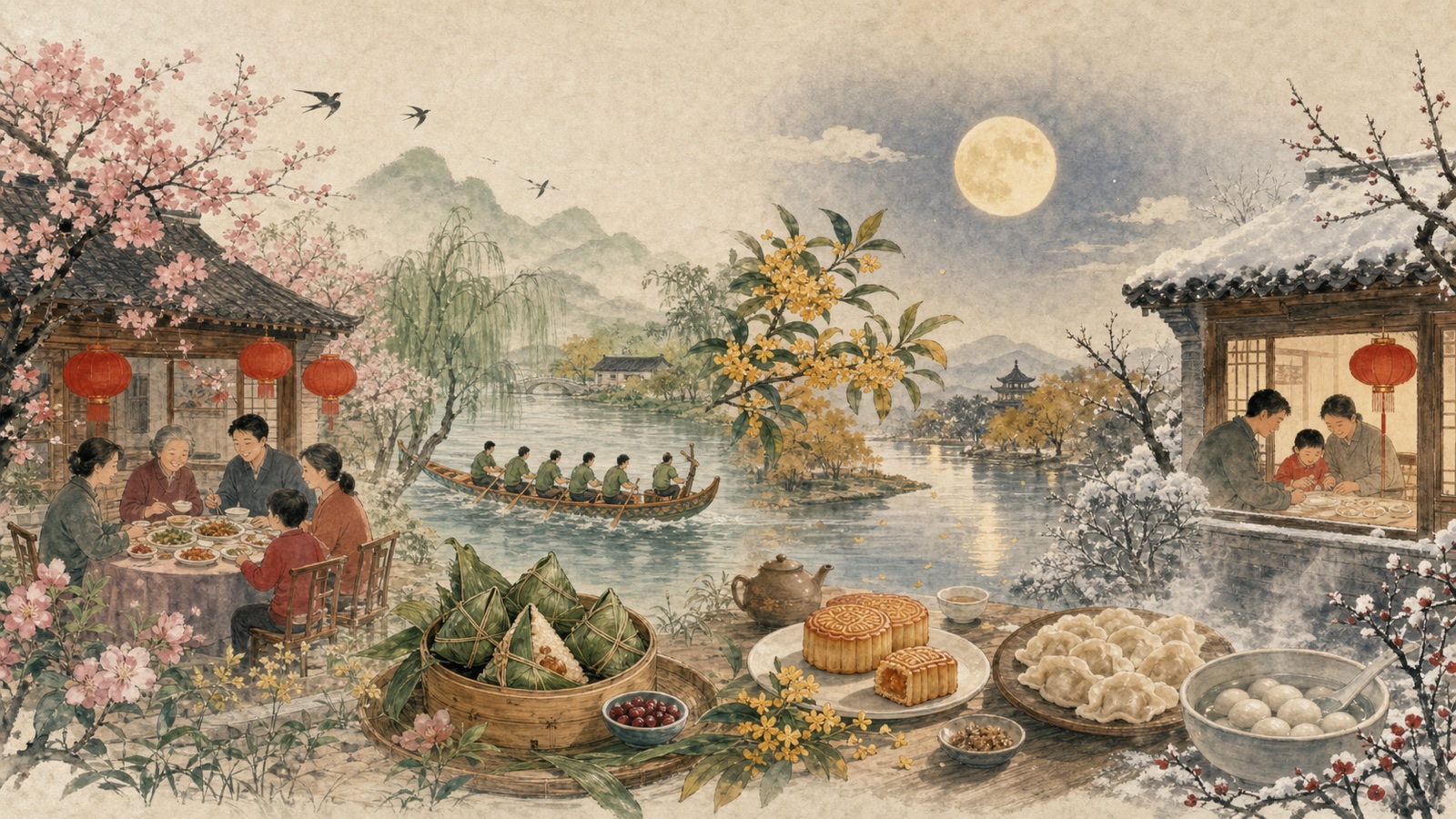
A seasonal story to start with: Double Ninth Festival
Double Ninth Festival is connected with mountain climbing, chrysanthemums, seasonal foods, and respect for elders in many modern contexts.
Date: Ninth day of the ninth lunar month. Next date: 2026/10/18.
Choose a culture guide
- Chinese Festival Guide - Major festivals, dates, foods, customs, and regional differences.
- Chinese Mythology & Deities - Classic-novel figures, deities, artifacts, source notes, and version differences.
- Chinese Mythology Places - Understand the legendary places that appear in Chinese mythology, classic novels, festival memory, and visual culture.
- Chinese Classics Guide - Use classic works as entry points into characters, places, artifacts, idioms, and modern adaptations.
- Mythology Relationship Maps - Understand who belongs together, which source they come from, and how figures connect across stories.
- Chinese Cultural Symbols - Explain common Chinese visual symbols that appear in art, festivals, mythology, architecture, clothing, and gifts.
- Mythology Idioms and Allusions - Learn the story behind idioms and allusions that appear in Chinese learning, animation, films, games, and cultural writing.
- Chinese Zodiac Guide - Zodiac signs and cultural background without prediction claims.
Recently Added Guides
Direct links to recently expanded mythology figure pages and Chinese mythology place guides.
New figure guides
- Nezha: Weapons, Powers, and Story Sources - Explore Nezha's weapons: Wind Fire Wheels, Fire-tipped Spear, Huntian Ling sash, and Qiankun Ring, with pictures, Chinese names, and source differences.
- Caishen / God of Wealth - Understand Caishen as a Chinese wealth-deity tradition, including Zhao Gongming, civil and military wealth gods, New Year rituals, and common symbols.
- Yue Lao / Old Man Under the Moon - Learn who Yue Lao is, how the red string of fate works in Chinese legend, and why the Old Man Under the Moon remains a major matchmaker figure.
- Yanluo Wang / King Yama - Who is Yanluo Wang? Meet King Yama, the judge of the Chinese underworld, and learn about his judgment ledger, Ten Kings context, and story traditions.
- Erlang Shen / Yang Jian - Erlang Shen and Yang Jian explained through his third eye, three-pointed weapon, Xiaotian Quan, Journey to the West, and Investiture of the Gods.
- He Xiangu - Learn who He Xiangu is, why she is usually the only woman among the Eight Immortals, her lotus symbol, and how origin stories vary.
- Zhang Guolao - Understand Zhang Guolao as one of the Eight Immortals, including the backwards donkey, fish drum, Tang court legends, longevity motifs, and version differences.
- Han Xiangzi - Understand Han Xiangzi as the flute-playing Eight Immortals figure, including the Han Yu legend, peony miracle, music symbolism, and source background.
New place guides
- Heavenly Court / 天庭 - Understand the Heavenly Court in Chinese mythology: Jade Emperor, celestial bureaucracy, Journey to the West, Investiture of the Gods, and visual symbols.
- Chinese Underworld / 地府 - Understand the Chinese Underworld, Yanluo Wang, judgment registers, ghost officials, Buddhist and Daoist influences, and folk storytelling.
- Dragon Palace of the Eastern Sea / 东海龙宫 - Learn about the Dragon Palace of the Eastern Sea in Chinese mythology, including Sun Wukong, Nezha, the Dragon King, and sea-palace imagery.
- Flower Fruit Mountain / 花果山 - Understand Flower Fruit Mountain in Journey to the West: Sun Wukong's origin, stone monkey story, monkey kingdom, and cultural image.
- Five Elements Mountain / 五行山 - Learn about Five Elements Mountain in Journey to the West: Sun Wukong's confinement, release by Tang Sanzang, and symbolic meaning.
- Flaming Mountains / 火焰山 - Understand the Flaming Mountains in Journey to the West, including Princess Iron Fan, Bull Demon King, the banana-leaf fan, and pilgrimage trials.
- Moon Palace / 广寒宫 - Discover Guanghan Gong, the Chinese Moon Palace: Chang'e, the Jade Rabbit, osmanthus trees, Hou Yi, and the palace's place in Mid-Autumn stories.
- Mount Penglai / 蓬莱仙山 - Understand Mount Penglai in Chinese mythology: immortal islands, Daoist imagination, sea mountains, poetry, painting, and decorative art.
- Mount Kunlun / 昆仑山 - Learn about Mount Kunlun in Chinese mythic geography, immortal mountains, western sacred space, Daoist imagination, literature, and art.
Chinese Festival Calendar
- Spring: Spring Festival, Lantern Festival, Qingming Festival
- Summer: Dragon Boat Festival, Qixi Festival, Zhongyuan Festival
- Autumn: Mid-Autumn Festival, Double Ninth Festival
- Winter: Winter Solstice, Laba Festival, Little New Year
Major traditional Chinese festivals
- Spring Festival (春节) - Spring Festival marks the start of the Chinese lunar year and is widely associated with reunion meals, New Year's Eve dinner, red envelopes, couplets, and visits to relatives.
- Lantern Festival (元宵节) - Lantern Festival closes the traditional New Year period with lantern viewing, riddles, and foods such as tangyuan or yuanxiao.
- Qingming Festival (清明节) - Qingming is connected with tomb sweeping, ancestor remembrance, and spring outings. Its observance is respectful and regionally varied.
- Dragon Boat Festival (端午节) - Dragon Boat Festival is known for zongzi, dragon boat racing, and customs such as hanging mugwort or calamus. It is widely associated with the story of Qu Yuan, but not limited to one origin story.
- Qixi Festival (七夕节) - Qixi is linked with the Cowherd and Weaver Girl story and older weaving or skill-praying customs, making it broader than the label Chinese Valentine's Day.
- Zhongyuan Festival (中元节) - Zhongyuan Festival is connected with remembrance, offerings, and folk religious practice in some communities. It is a respectful memorial and ritual tradition, not horror content.
- Mid-Autumn Festival (中秋节) - Mid-Autumn Festival centers on the moon, mooncakes, family reunion, moon viewing, and regional food styles. It also has influence across East Asia and overseas Chinese communities.
- Double Ninth Festival (重阳节) - Double Ninth Festival is connected with mountain climbing, chrysanthemums, seasonal foods, and respect for elders in many modern contexts.
- Laba Festival (腊八节) - Laba Festival is commonly associated with Laba porridge and preparation for the New Year season, with different emphasis across regions.
- Little New Year (小年) - Little New Year is a preparation period before Spring Festival. Its date itself varies by region, often the 23rd or 24th day of the twelfth lunar month.
- Winter Solstice (冬至) - Winter Solstice is one of the 24 solar terms and also has festival significance. Many northern regions eat dumplings, while many southern regions eat tangyuan.
Regional Traditions
Chinese festival customs vary by region, ethnicity, and family tradition. Northern and southern patterns are common tendencies rather than absolute rules.
Frequently Asked Questions
Why does Chinese New Year change dates every year?
Chinese New Year follows the Chinese lunisolar calendar, not a fixed Gregorian date. It begins on the first day of the first lunar month, so its Gregorian date usually falls between late January and mid-February.
What are the most important traditional Chinese festivals?
Spring Festival, Lantern Festival, Qingming Festival, Dragon Boat Festival, Qixi Festival, Mid-Autumn Festival, Double Ninth Festival, Laba Festival, Little New Year, and Winter Solstice are commonly discussed traditional festivals or festival-related dates.
Why are festival foods different between northern and southern China?
Food customs are shaped by local crops, climate, history, migration, and family tradition. Many northern areas have wheat-based foods, while some southern areas use more rice-based foods, but these patterns are not absolute.
What is the difference between lunar festivals and solar-term festivals?
Lunar festivals are defined by lunar month and day, such as the 15th day of the eighth lunar month for Mid-Autumn Festival. Solar-term festivals or dates are tied to solar terms, such as Qingming and Winter Solstice.
How do Chinese families celebrate traditional festivals today?
Many families combine older customs with modern routines. Common practices include family meals, seasonal foods, travel, visits to relatives, local events, and online greetings, depending on the festival and region.
Editorial note
Chinese festival customs vary by region, ethnicity, and family tradition. The summaries below focus on common practices rather than one fixed rule for all Chinese communities.