Chinese Cultural Symbols in Mythology, Art, and Festivals
Explain common Chinese visual symbols that appear in art, festivals, mythology, architecture, clothing, and gifts.
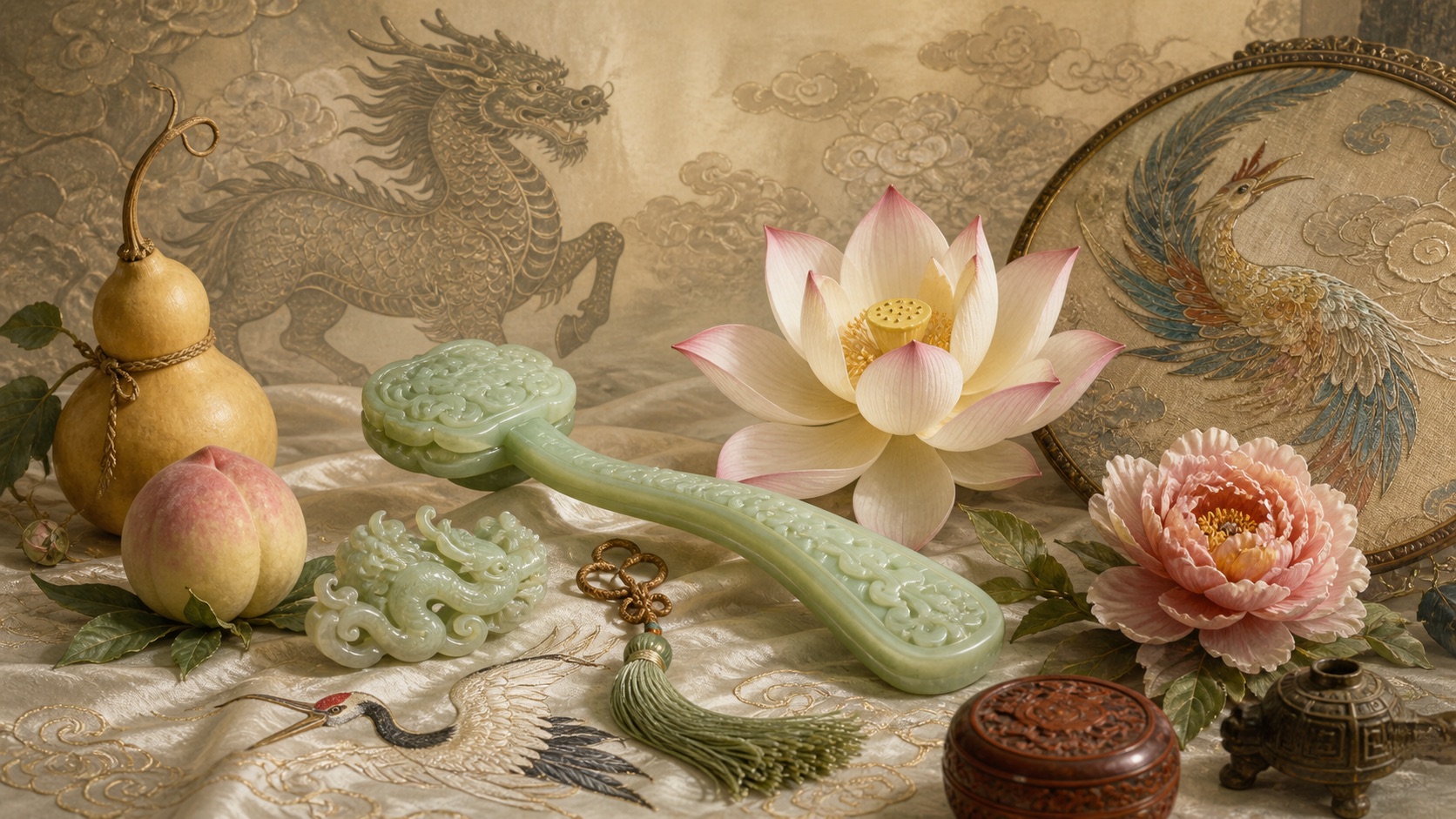
What this guide covers
Cultural symbols are different from magic weapons. They may appear on clothing, architecture, porcelain, festival objects, paintings, or names, and their meanings often change by context.
Chinese Cultural Symbols
-
Chinese Dragon / 龙
Long
The Chinese dragon is associated with rain, power, transformation, imperial imagery, and auspicious visual culture.
Appears in: Architecture, clothing, festivals, mythology, decorative art
-
Fenghuang / 凤凰
Feng Huang
Often translated as phoenix, fenghuang has its own Chinese symbolic history connected with harmony, virtue, and elegant visual pairing.
Appears in: Wedding imagery, court art, textiles, decorative motifs
-
Qilin / 麒麟
Qi Lin
The qilin is a benevolent mythic creature commonly connected with auspicious arrival, virtue, and refined decorative art.
Appears in: Mythology, painting, sculpture, decorative objects
-
Lotus / 莲花
Lian Hua
The lotus appears in Buddhist art, poetry, painting, and naming culture with meanings of purity, resilience, and refined beauty.
Appears in: Buddhist art, poetry, painting, names, festivals
-
Gourd / 葫芦
Hu Lu
The gourd can be a container, Daoist icon, folk protective object, and sound-related auspicious symbol because hulu echoes ideas of blessing and prosperity.
Appears in: Daoist imagery, folk objects, home decoration, paintings
-
Ruyi / 如意
Ru Yi
Ruyi means 'as desired' and appears as a ceremonial object, decorative motif, and auspicious phrase in gift culture.
Appears in: Court objects, gifts, decorative art, auspicious phrases
-
Jade / 玉
Yu
Jade is a valued material associated with refinement, ritual, moral beauty, and long-standing Chinese decorative culture.
Appears in: Jewelry, ritual objects, names, museum collections
-
Peach of Immortality / 仙桃
Xian Tao
The peach is strongly connected with longevity, birthday imagery, immortals, and the Queen Mother of the West in mythic contexts.
Appears in: Birthday art, immortality stories, decorative painting
How to read a Chinese symbol in context
Start with the object: a birthday gift, court robe, Buddhist image, and festival decoration can use the same motif for different purposes. Look at the date, material, inscription, and nearby figures before assigning a meaning. A motif may express a wish, identify a religious figure, or refer to a story; it does not promise a real-world outcome.
Read combinations as well as individual objects. The Palace Museum explains that auspicious designs often use both associations and similar-sounding words. Fish can express abundance, peaches can offer a birthday wish, and several motifs together can form a longer blessing. Translating each picture separately may miss that combined message.
Three examples: textile, birthday image, and gift
On a Ming-dynasty textile in The Met, phoenixes alternate with lotus flowers that carry the Eight Buddhist Treasures. This is a useful reminder to look beyond the phoenix alone: the lotus, additional objects, and imperial workshop context help explain the complete design. A bird-and-flower pattern is not always simply a wedding emblem.
For a peach-and-immortal birthday image, begin with the longevity theme. The Met's account of longevity in Chinese art connects peaches with the Queen Mother of the West's orchard and explains the wider language of birthday wishes. Check whether the painting also includes Shou Xing, cranes, or written birthday greetings rather than identifying the scene from one peach alone.
For a ruyi-shaped gift or decorative border, the phrase ruyi means 'as you wish.' The Met records that ruyi scepters were given as gifts for their good wishes and were also arranged on stands or in vases. Shape and placement matter: a cloud-like outline may be a repeated decorative motif, while a hand-held scepter is an actual object in the scene.
Choosing symbols for names, gifts, or creative work
Choose the occasion before the motif. A longevity wish is suitable for a birthday context; a religious attribute needs its religious context explained; an imperial emblem should be described with its historical setting. For a name, check the actual Chinese characters and pronunciation separately: liking a jade or lotus image does not establish that any combination of characters will sound like a natural Chinese name.
When describing an unfamiliar object, use a specific observation such as 'a peach motif commonly associated with longevity' and include the museum label or source. Avoid claiming that one symbol has an identical meaning in every region, period, or family. Modern logos, tattoos, animation, and souvenirs can reuse older forms with new meanings.
Frequently asked questions
Do Chinese cultural symbols have one fixed meaning?
No. Meaning depends on the period, object, inscription, other motifs, and religious or social setting. Start with the object label and interpret the whole design.
Why do fish, bats, and other objects express good wishes?
Some designs use rebuses: the name of a pictured object sounds like a word in a blessing. The Palace Museum gives fish and abundance, and bats and blessing, as examples. The intended phrase still depends on the complete composition.
Is a lotus always a Buddhist symbol?
No. A lotus can appear in Buddhist imagery, but it also occurs in poetry, decorative art, and auspicious combinations. Look for figures, accompanying objects, and inscriptions before deciding the context.