Chinese Mythology Idioms and Classic Allusions
Learn the story behind idioms and allusions that appear in Chinese learning, animation, films, games, and cultural writing.
What this guide covers
A mythology idiom page should give the literal wording, natural English meaning, story source, related figures, and modern usage without turning the idiom into a mechanical word-for-word translation.
Mythology Idioms and Allusions
-
Ba Xian Guo Hai / 八仙过海
Ba Xian Guo Hai
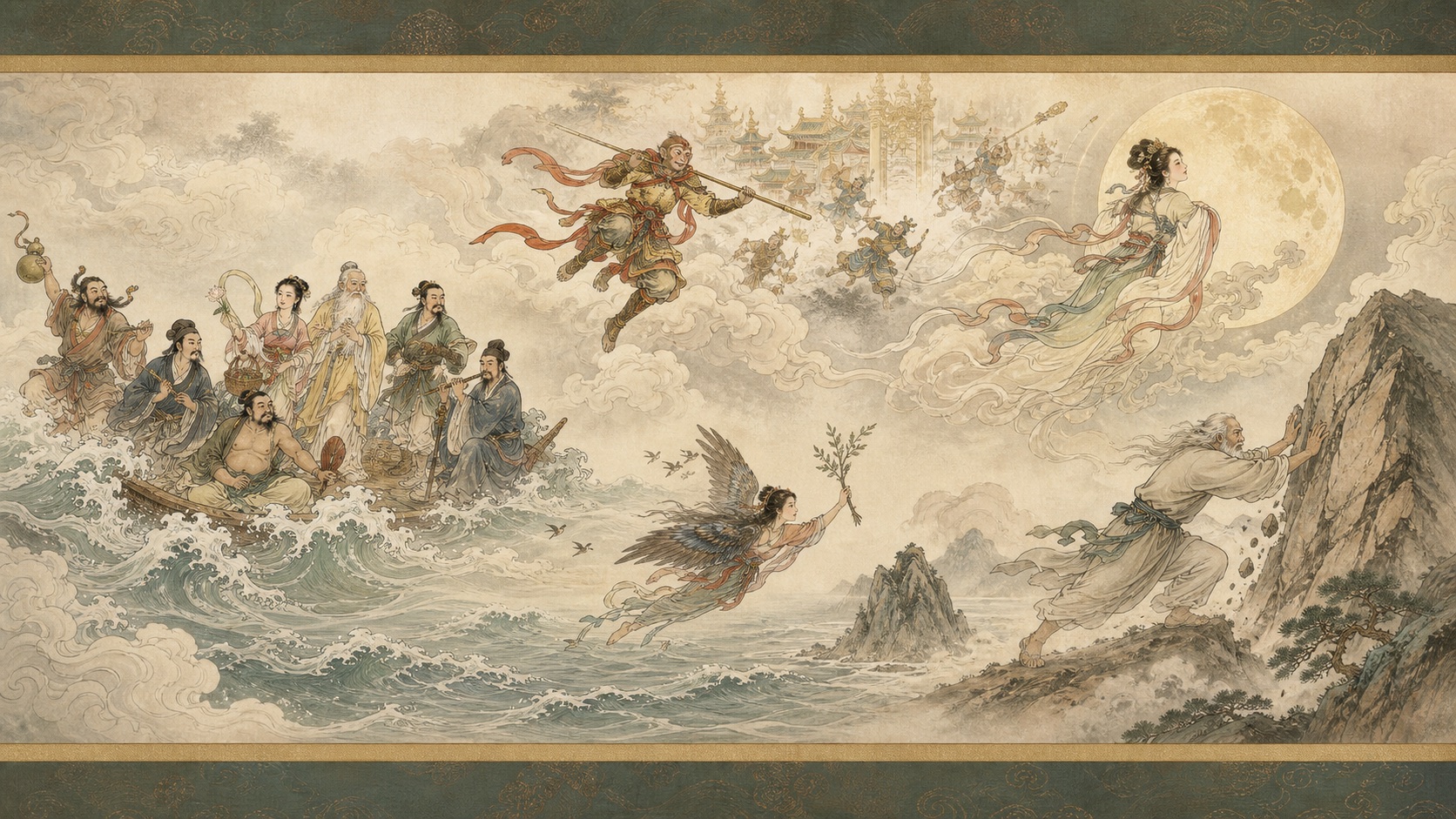
The Eight Immortals cross the sea using their own powers or objects. Today it often means everyone shows their own method or skill.
Appears in: Eight Immortals stories, theater, animation, everyday speech
-
Havoc in Heaven / 大闹天宫
Da Nao Tian Gong
Sun Wukong challenges the Heavenly Court before being subdued. The phrase now evokes a dramatic disruption of an established order.
Appears in: Journey to the West, animation, opera, film
-
Fiery Eyes and Golden Pupils / 火眼金睛
Huo Yan Jin Jing
A Sun Wukong ability associated with seeing through demons and disguises. In modern language it can describe sharp perception.
Appears in: Journey to the West and modern usage
-
Nezha and the Sea / 哪吒闹海
Ne Zha Nao Hai
A famous Nezha episode involving conflict with the Dragon King's world. It is widely retold in animation, film, and children's culture.
Appears in: Nezha stories, Investiture-related tradition, animation
-
Chang'e Flying to the Moon / 嫦娥奔月
Chang'e Ben Yue
Chang'e ascends to the moon in a story cycle connected with immortality medicine, Hou Yi, and Mid-Autumn cultural memory.
Appears in: Ancient myth, Mid-Autumn Festival, poetry, art
-
Jingwei Filling the Sea / 精卫填海
Jing Wei Tian Hai
A small bird repeatedly carries twigs and stones to fill the sea. It is often used to describe determined persistence.
Appears in: Ancient myth and idiom learning
-
Yu Gong Moves the Mountains / 愚公移山
Yu Gong Yi Shan
An old man keeps working to move mountains blocking his home. It became a powerful image of determination across generations.
Appears in: Classical allusion, education, modern speech